

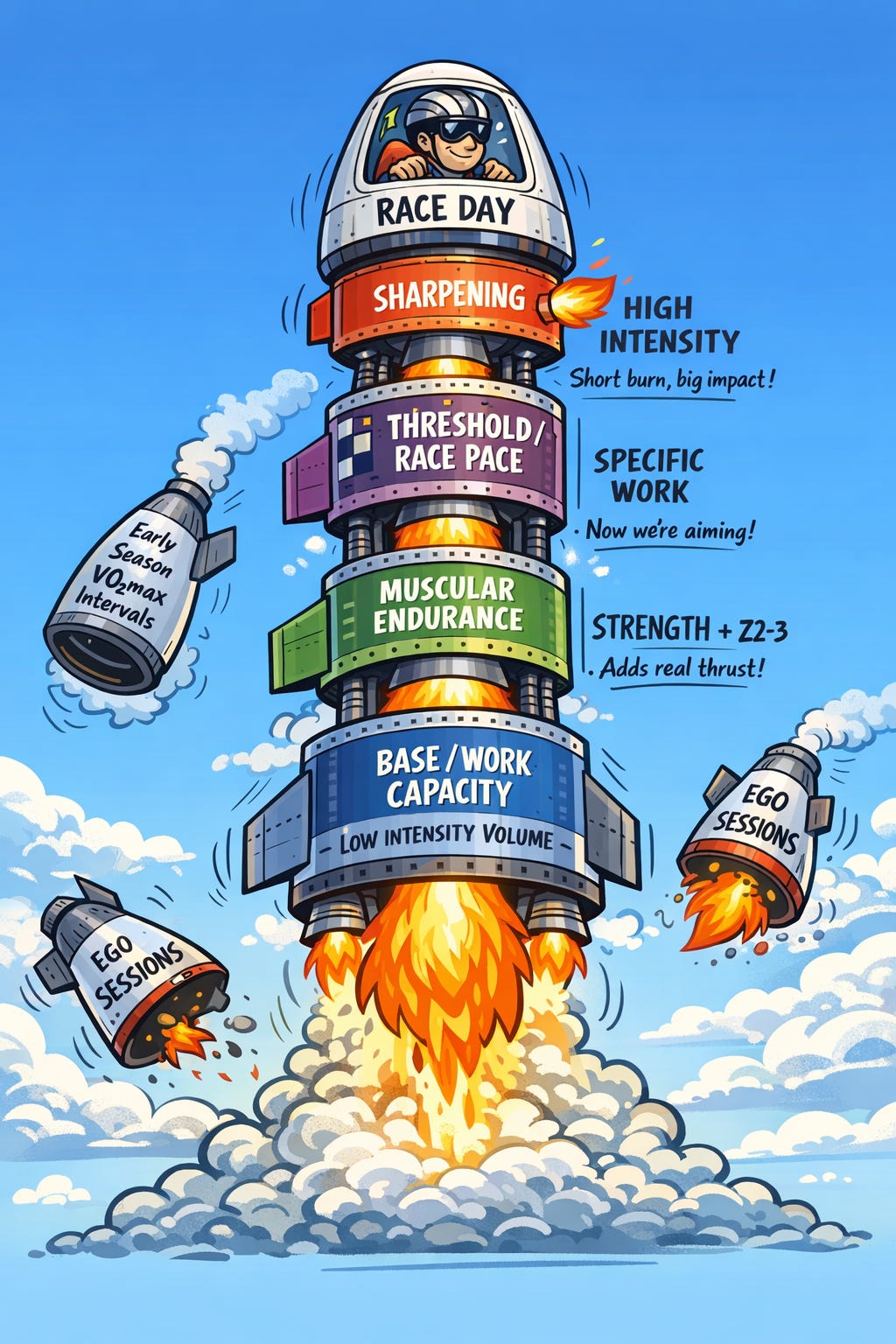
“Putting together a good training plan is rocket science” - me
It’s a sad fact: Most athletes don’t arrive at their A-Race start line at their fitness peak.
They sign up for their race, often pay significant sums of money, put in a year or more of solid work, but rack up to the start line of the big event knowing that they aren’t where they should be. And, as such, often get beaten by athletes who have put in less total work, but are better prepared because the work was progressive and properly sequenced.
They fail because they trained chaotically, swayed by their motivation in the moment, coupled with whatever methodology happened to cross their current timeline. They might have included all of the pieces of the puzzle at various points throughout the year, but they put the right training in the wrong place. For example…
Too much intensity too early.
Too much fatigue carried too late.
Too much dispersion of the “good sessions”… that never quite add up to a great season.
And the frustrating part?
In a global sense, they know they did “the work”; they just didn’t get the timing right.
And that’s what this one will be about - setting up your season plan to ensure you get the timing right.
When it comes to the time-course of the different physiological adaptations, it helps to think of your season like a rocket…
It’s not powered only by one big (base) engine, but by a sequence of carefully timed boosters - each one designed to fire at exactly the right moment, do its job, and then get out of the way.
Get the sequence right, and you “have lift off” - arriving at race day with maximum speed and precision.
Get it wrong?
You have a bunch of random misfires that never give you the power that you need to achieve the altitude you desire, the altitude you deserve.
In the last article, we looked at this concept of “timing” and the underlying principles that govern how training actually works:
Delayed training effects
Residual training effects
The idea that fitness is built not just from what you do, but when you do it
We covered all of the key theoretical concepts. But theory doesn’t win races - practical execution does. So, in this piece, we’re going to move from theory to application - to what this actually looks like when you sit down with a blank calendar and try to build a season that peaks exactly when it matters.
To do that, we’ll start with a simple model.
Not a perfect athlete. Not a special case.
Just… Mr. Middleman.
About as “middle of the road” as you can get - a middle-aged, intermediate athlete preparing for a middle-distance triathlon, with middle-of-the-road physiology and a fairly typical training response.
Why start here?
Because if you can understand how a typical season should unfold, you’ll have a reference point - a blueprint = that makes it far easier to recognize when (and how) to adjust for your own unique strengths and limitations.
We’ll get to how to adjust for some of those individual differences in the next piece.
But first, we need a baseline.
Below you’ll find that baseline - a sample season template that illustrates how training load, intensity, and timing interact across the year - how we stack adaptations, manage fatigue, and ultimately bring everything together for a peak at exactly the right moment.
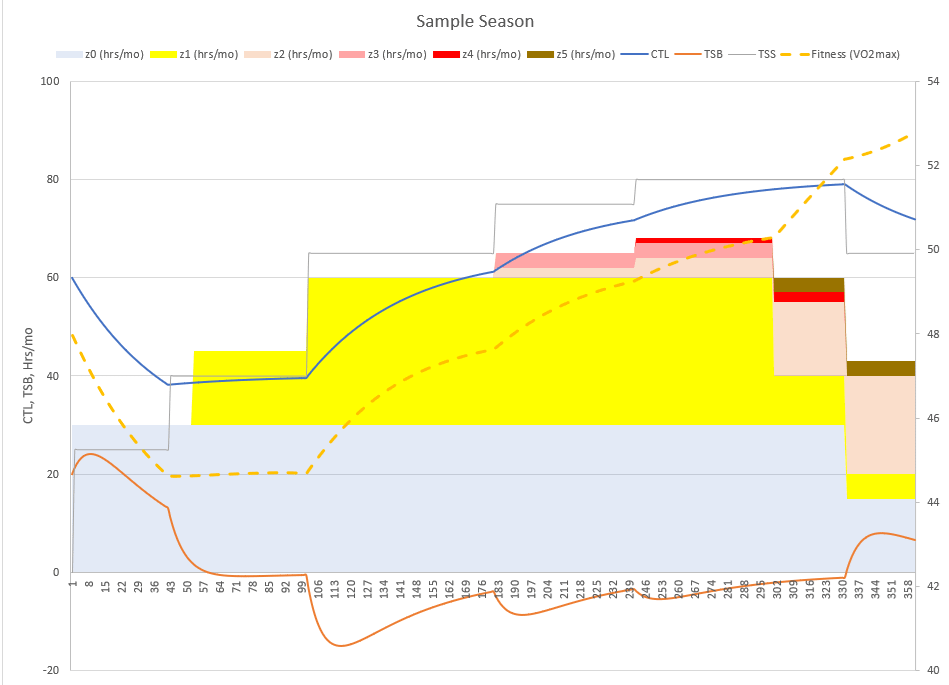
Let’s begin with a brief rundown on what is included in this very busy Annual Training Plan chart….