

While writing The Endurance Code, I kept coming back to one key observation…
“Muscle moves stuff”
It doesn’t matter whether that “stuff” is a barbell or your own body. Ultimately, if you want to move a mass faster, you must apply more force - and apply it at the right time and in the right direction.
Consider an Ironman athlete pedaling at 90 rpm and producing 200 watts at his aerobic threshold, i.e. making full use of the majority of his slow-twitch muscle fibers. If cadence remains constant and the athlete wants to produce 220 watts, they must generate approximately 10% more torque (i.e., force) through each pedal cycle with those fibers. In order to produce that larger amount of force, those muscle fibers will need to become larger or stronger in some way, shape, or form.
Importantly, here, all of the positive adaptations covered in The Endurance Code, that come with endurance training, e.g improved oxygen delivery, greater mitochondrial density, and increased fat oxidation, help the athlete become more efficient - that is, to fuel and repeatedly sustain those muscular contractions. But they don’t remove this fundamental mechanical requirement for going faster:
To go faster, more force must be produced!
At a certain point, therefore, improving endurance performance requires us to address strength.
Of course, for strength and power athletes this is even more the case. In modern training for power/speed sports, time in the weight room features heavily. While athletes can develop specific neural adaptations that result in improved strength and power for a given amount of muscle mass, these gains are relatively limited when compared to the morphological changes that can occur with a long period of strength training. And, ultimately, if an athlete wishes to throw further, sprint faster, or jump higher, over a long period of development, they must find ways to continually increase their ability to apply more force.
Not only does strength become a potential limiter in power production, it can also become a limiter in endurance. The ability to maintain good mechanics as fatigue accumulates, tolerate training, and remain durable across a long season is largely dependent on the durability of your muscles. Athletes who struggle with weak muscles susceptible to damage are unable to fully express their metabolic and cardiovascular fitness, experiencing degradation in ability to produce power both across a race and across a training build.
These concepts are an essential element of an effective training plan and something that I wanted to cover from the outset of writing The Endurance Code – only problem was – I ran out of space! Even at the largest size book, and the highest possible number of pages, the Endurance Code hit up against the publishing limit and so it became clear that strength deserved more than a section, or an abridged chapter, it deserved its own book!
In fact, it deserved a complete system of its own.
So, I’ve decided to begin work on a companion book:
The Strength Code: The Science and Practice of Maximal Athletic Development
Although it has grown out of my work with endurance athletes, this will not simply be a book about “strength training for endurance athletes.”
For this one, I’m shooting much broader.
In The Strength Code, I want to explain how we systematically develop a complete athlete - from movement competency and tissue capacity to muscle, maximum strength, explosive power, and the ability to repeatedly express that strength without breaking down.
In other words, this will be a book for anyone who wants to become stronger, more powerful, more capable, and more durable.
Strength is more than lifting heavy weights
Over the course of my coaching career I’ve been exposed to a number of top-grade strength coaches – many whose philosophy grew out of the periodization programs of the Eastern Bloc countries, looking at strength training as a multidimensional blending of a number of aspects – dynamic mobility, muscle balance, tissue tolerance, muscular hypertrophy, neural strength and, finally, sport-specific application of the above. These days, however, with the rise of the internet influencer, it seems that we have re-entered a strength training dark age that looks at strength training as simply lifting heavy weights.
These days, when most people hear the words strength training, they often think of one particular style of training.
Some picture bodybuilding: sets of eight to twelve repetitions designed to build muscle.
Others picture powerlifting: heavy squats, bench presses, and deadlifts.
Others picture CrossFit or HYROX: resistance exercises performed quickly and under substantial metabolic fatigue.
Others still think of corrective exercise, functional training, or physical rehabilitation.
Each of these methods can be useful. Problems arise when one method is mistaken for a complete system, or the one method is applied without regard for the athlete’s needs, competency, and total training load.
Ultimately, a comprehensive, balanced athlete will require elements of all of the above methods at different times in their development!
The beginner may first need to develop sufficient movement competency and tissue tolerance to train consistently. Another athlete may possess plenty of mobility but lack the stability to control it. A more experienced athlete may need additional muscle, maximum strength, explosive power, or fatigue resistance.
Therefore, the question isn’t:
Which system of strength training is best?
The question is:
What physical quality does this athlete need next, and what is the safest and most efficient way to develop it?
This is a direct extension of the core questions that we introduced in The Endurance Code…
1/ Is the training producing the desired adaptation?
2/ If not, why not?
3/ Based on that information, what is the next right move for this athlete?
These will also be the central questions of The Strength Code.
And, because the answers to those questions will change over the athlete’s long-term development, The Strength Code is not about just one of the elements of strength training mentioned above. No. It is…
A complete system for developing the complete athlete!
With that in mind, the overall developmental framework for the book is:
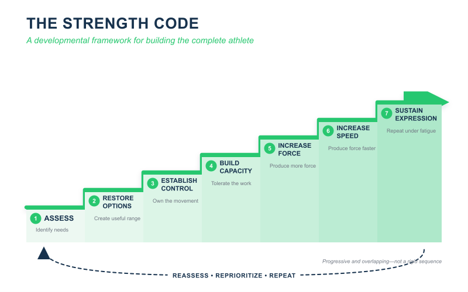
First, we assess the athlete and the demands of their sport.
Where necessary, we restore useful movement options.
We then develop the control required to use those options effectively.
From there, we build the athlete’s capacity for training - their technical competency, tissue tolerance, general muscular development, and strength-training work capacity.
Once that foundation is established, we can place greater emphasis on muscle growth, maximum force production, explosive power, or muscular endurance according to the athlete’s individual needs.
This is not intended to be a rigid staircase in which we permanently “complete” one quality before moving to the next.
Mobility, stability, hypertrophy, strength, power, and muscular endurance overlap. Advanced athletes continue to train most of these qualities throughout the year. What changes is the relative emphasis and the minimum dose required to maintain the qualities that are not currently the priority.
We will go into detail on just how, from a very practical perspective, we go about “blending” these objectives across a training session, a week, a season, and a lifelong athletic development.
But, overall, similar to endurance development, the goal is to identify what is currently limiting this athlete and prioritize the various elements of a comprehensive strength training plan accordingly.
Assessment before prescription
As you probably gathered when reading The Endurance Code, I like tests and benchmarks very much :) In fact, I don’t believe you can put together an effective training program without them. And, this one will be no different - a significant section of the book will focus on assessing the individual athlete.
This will include:
individual range-of-motion testing;
manual muscle testing;
functional movement screening;
strength and strength-endurance testing;
jumping and reactive-strength assessment;
identifying common movement constraints and compensatory patterns.
However, counter to some “systems” that assume fragility and demand that athletes be impossibly perfectly “in balance” before doing any real training, these assessments won’t be presented as diagnostic tools or crystal balls for predicting injury. Nor will every asymmetry be labeled a dysfunction that must be corrected before the athlete actually trains.
Their purpose is far more practical than that:
To improve our decisions in making the athlete better while managing (and addressing) risk.
When a movement looks “sketchy” or potentially risky, we need to ask why. Is the limitation caused by unavailable range of motion? Is the range available passively but not actively? Is the athlete weak in that position? Are they unfamiliar with the movement? Are they protecting a painful area? Or does the exercise simply not suit their structure?
The same visible movement problem can have several different causes - and therefore shouldn’t automatically receive the same corrective exercise.
The assessment process should help us decide whether to:
Restore, strengthen, modify, monitor, or refer.
Corrective exercise (and corrective yoga)
I introduced Yoga in the endurance code as a key recovery protocol – a way to downregulate, to “flip the switch” from a sympathetic-dominant “fight or flight” nervous system to the parasympathetic “rest and recover” state that we need the athlete to be in to grow – to get better.
In this book I also want to explore the use of yoga as a corrective training tool.
Traditional yoga poses are generally taught as standard shapes. The only problem is, athletes don’t arrive with standardized bodies, histories, or movement needs!
A pose that helps one athlete develop useful hip mobility may encourage another athlete to further compensate through the lumbar spine. A passive stretch that benefits an athlete with genuinely restricted range may be counterproductive for a hypermobile athlete who already has more movement than they can control.
Unfortunately, yoga is often sold as a great way to restore mobility and balance in an athlete. However, a yoga pose is not inherently corrective, and a dirty little secret of the yoga world is that many teachers & yogis struggle with lingering musculoskeletal issues, despite being globally very flexible. We certainly don’t want our yoga to worsen any dysfunctions or imbalances that the athlete may have; we want it to balance these out, to improve them. We want our yoga, in addition to being relaxing and aiding recovery, to be corrective.
Yoga becomes corrective when it is selected and modified for a particular athlete, in line with the individual limitations and objectives.
With this goal in mind, we will look at how traditional poses can be modified using changes in stance, support, range of motion, muscular activity, breathing, and props such as blocks, straps, bolsters, walls, and chairs to address and correct specific movement issues.
Most importantly, every intervention will connect back to that initial assessment finding and a relevant retest:
Did the intervention produce the change we wanted - and did that change improve the athlete’s movement or performance?
Building the strength base - and measuring it
Just as endurance athletes need an aerobic base, strength athletes need a strength-training base.
Before an athlete can benefit from sustained periods of heavy or explosive training, they must possess the technical competency, tissue tolerance, general muscular development, and recovery capacity necessary to tolerate the work.
A key metric within this section will be tonnage:
Total tonnage = Sets x Repetitions x LoadTonnage is not a complete measure of training stress. Ten tonnes of leg pressing is not equivalent to ten tonnes of squatting, and tonnage captures body-weight exercises, isometrics, and plyometrics poorly. However, just like measuring total calories of work in endurance training, when exercise selection and counting conventions remain reasonably consistent, tracking plain ol’ tonnes lifted can be an extremely useful way to quantify an athlete’s work capacity and progression.
We will examine tonnage at the exercise, session, weekly, and training-block levels. I’ll also present practical target ranges for the different levels and types of athletes introduced in The Endurance Code - from the Level 1 “Metabolic Melvin” health-and-fitness athlete all the way to the Level 6 “World-Class Wendy” - while accounting for body mass, relative intensity, sport demands, and the athlete’s other training.
While tonnage is the number, the overall objective isn’t simply to lift more weight each week. It’s to develop the overall work capacity to complete, recover from, and adapt to the amount of training required for the athlete’s next level of development.
Planning the strength training program across every timescale
As with The Endurance Code, this book will connect individual workouts to the larger developmental plan.
We’ll examine strength development across:
the athlete’s lifetime;
the annual plan;
the training block;
the training week;
the individual session.
We will also examine how strength fits alongside endurance training, speed development, sport practice, competition, work, family, and the many other demands placed on a real athlete.
Strength training is, in many ways, one of the most stressful forms of training that the athlete will undertake, and the best strength program on paper is not the best program if the athlete can’t recover from it – or if it takes away from their other sport-specific training or overall life!
Planned Contents
The following is the current working outline. The current plan is to follow the same general pattern as The Endurance Code. However, just like The Endurance Code, I’ve no doubt it will evolve as I write and in response to your (dear reader’s :) feedback.
Part I — Understanding the Athlete
What Is Strength?
First Principles of Effective Strength Training
Modeling the Strength Athlete
Assessing the Athlete
Part II — Restoring and Building the Foundation
Understanding Movement Dysfunction
Corrective Training and Mobility
Stability, Control, and Movement Skill
Building the Strength Base
Part III — Developing the Components of Strength
Hypertrophy: Building the Athlete’s Engine
Maximum Strength: Increasing Force Capacity
Power and Explosive Strength
Muscular Endurance and Strength Endurance
Part IV — Programming the Strength Athlete
Exercise Selection and Transfer
Prescribing the Training Dose
Fatigue, Recovery, and Adaptation
Part V — Planning Across Time
Long-Term Strength Development
Designing the Annual Strength Plan
Designing the Training Block
Designing the Training Week
Designing the Strength Session
Monitoring and Adjusting Training
Part VI — Applying the System
Strength Across Sports
Athlete Archetypes and Practical Programs
Supporting resources will include assessment forms, movement-pattern profiles, a corrective-yoga library, exercise progressions, programming templates, testing protocols, tonnage calculators, and example programs.
Strength for endurance athletes - and everyone else
My background means that strength training for endurance athletes will receive particular attention…
We’ll explore how strength affects running, cycling, swimming, triathlon, rowing, skiing, and other endurance sports. We will look at concurrent training, the interference effect, fatigue management, strength maintenance during high-volume endurance phases, and how to become stronger without adding unnecessary mass.
But this is not an endurance training book – that was the other one! 😊 This one will cover strength training comprehensively and will show how, while the relative emphases may differ, the exact same framework can be applied to a developing youth athlete, a field- or court-sport player, a recreational lifter, a masters athlete, or someone training primarily for health and longevity.
The developmental principles remain consistent. What changes is the required dose, the relative importance of each quality, and the way that strength must ultimately be expressed.
Building the book in public
As I did with The Endurance Code, I plan to release early versions of the chapters here on Substack.
Just like the Endurance Code, these will be working chapters rather than immutable final versions. I make no apologies for this. It’s by design. You all helped me write the first one and I’ve no doubt that you will help me write this one as well. Your questions and feedback will help reveal where an explanation needs greater clarity, where an important topic is missing, and where the practical applications need to go deeper.
Fundamentally, my aim, just like the first one is to produce a workbook for those ready to do the work, i.e. a practical guide that explains how to develop an athlete from beginning to end—and enables coaches and self-coached athletes to incorporate the useful parts directly into their own training.
With that in mind, to kick things off, I would particularly welcome your thoughts on three questions:
Which aspect of strength development do you find most confusing?
Which assessments or training metrics do you currently use?
Are there any athlete types, sports, or practical situations that you would particularly like the book to address?
Please leave your suggestions in the comments. This outline is provisional, and your feedback will help shape what the book ultimately becomes.
The first chapter will begin with the most fundamental question of all:
What do we actually mean when we call someone strong?
For those who were on the long Endurance Code journey with me, I hope you’ll stick around for this one.
For those new to the Science & Practice of Maximal Athletic Development series, I hope you’ll join us. 🙏
Thanks Alan 🙏 my question is where in your view, does torque training fit into the strength equation for cyclists? Is it something you program for your athletes? Some view it as a Segway from weight room to the on bike performance - is that something you agree with or does it have value in itself? Very much appreciated.
Hi Alan. I'm excited to hear you're doing this. I'm a physician building a specialty practice dedicated to improving health through exercise and other lifestyle changes. I've been avidly reading your posts for several years now, both here and on the forum. Your writing has been fundamental for my understanding of exercise physiology, so thank you for what you do! I have a couple of thoughts on your questions. I'm most interested in learning how to apply strength development principles to those in the Metabolic Melvin/Fiona Fun Runner range. I have no idea whether there would be a lot of detail for you to explore in this range (the general health and fitness athlete), but I would find it very helpful. Second, I'd love to see examples of how you would program for strength training and aerobic training in a weekly or bi-weekly schedule (or if it is better to periodize both over a longer time frame). Combining strength and aerobic fitness has been shown to be the most beneficial approach for improving health and intrinsic capacity over the long term. Over the course of my own life, I've attempted to train both but repeatedly run into problems of too much volume, too little time, indecision between which to train first on a given day, etc. Any insight you can share on this would be very helpful. Thanks again for all the info you've already shared!