

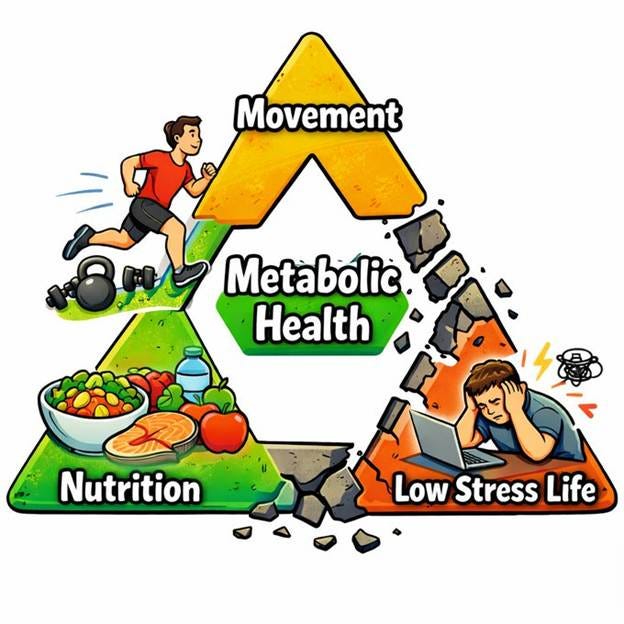
Ample Movement 🚶
Healthy Nutrition 👨🍳
Low-Stress Living 🧘
Remove one… and the whole structure begins to fail.
You can’t out-diet a lack of movement.
You can’t power your body on low-octane fuel.
You can’t efficiently burn fat with chaotic stress hormones.
For foundational health, you need all three.
Metabolic Health Is About Flexibility, not Fitness
One of the most persistent misconceptions I see - both in athletes and in otherwise health-conscious individuals - is the belief that metabolic health is synonymous with body composition or aerobic fitness. In reality, metabolic health runs much deeper than either. It reflects how effectively the body regulates fuel supply, storage, and utilization across ever-changing energy demands…
At its core, metabolic health is about whether the body can supply the right fuel, at the right time, in the right amount, without instability or excessive hormonal cost.
In athletes with strong metabolic health, we typically see stable energy levels throughout the day, smooth transitions between intensities during training, and predictable recovery patterns. In contrast, metabolically fragile athletes often experience energy crashes, strong dependence on carbohydrate intake, inconsistent recovery, and difficulty sustaining training loads despite appearing outwardly “fit”.
And, make no mistake about it, good aerobic fitness coupled with very poor metabolic fitness and health is not uncommon…
There are many athletes out there with impressive VO2max numbers, with top-level threshold output, with single digit body-fat levels, who are in absolutely awful metabolic shape. I see it in the lab all the time…
One key way that we can assess metabolic fitness is to look at what fuel the athlete is burning at rest (and low-intensity efforts) – a very simple way to do this is to hook the athlete up to a metabolic cart, have them lie down, take a nap if they like 😊, and record their fuel burn while in a completely rested state.
And, when we do this, we often get some surprises…
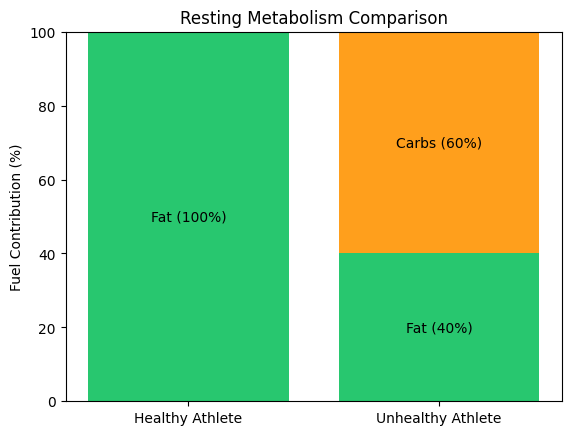
Athletes who put up really strong values on the VO2max test, often put up really abysmal values in the resting metabolic test, i.e. it is not uncommon to see athletes with VO2max values of 60ml/kg/min or more who are dependent on getting 60% of their resting energy requirements from carbohydrate!
These are typically the type of athlete who gets their impressive fitness from excessive intensity rather than volume – always reinforcing one particular energy system – glycolysis.
They are the type of athlete who (often because of this training bias) overeats carbohydrate – both within and away from training…