

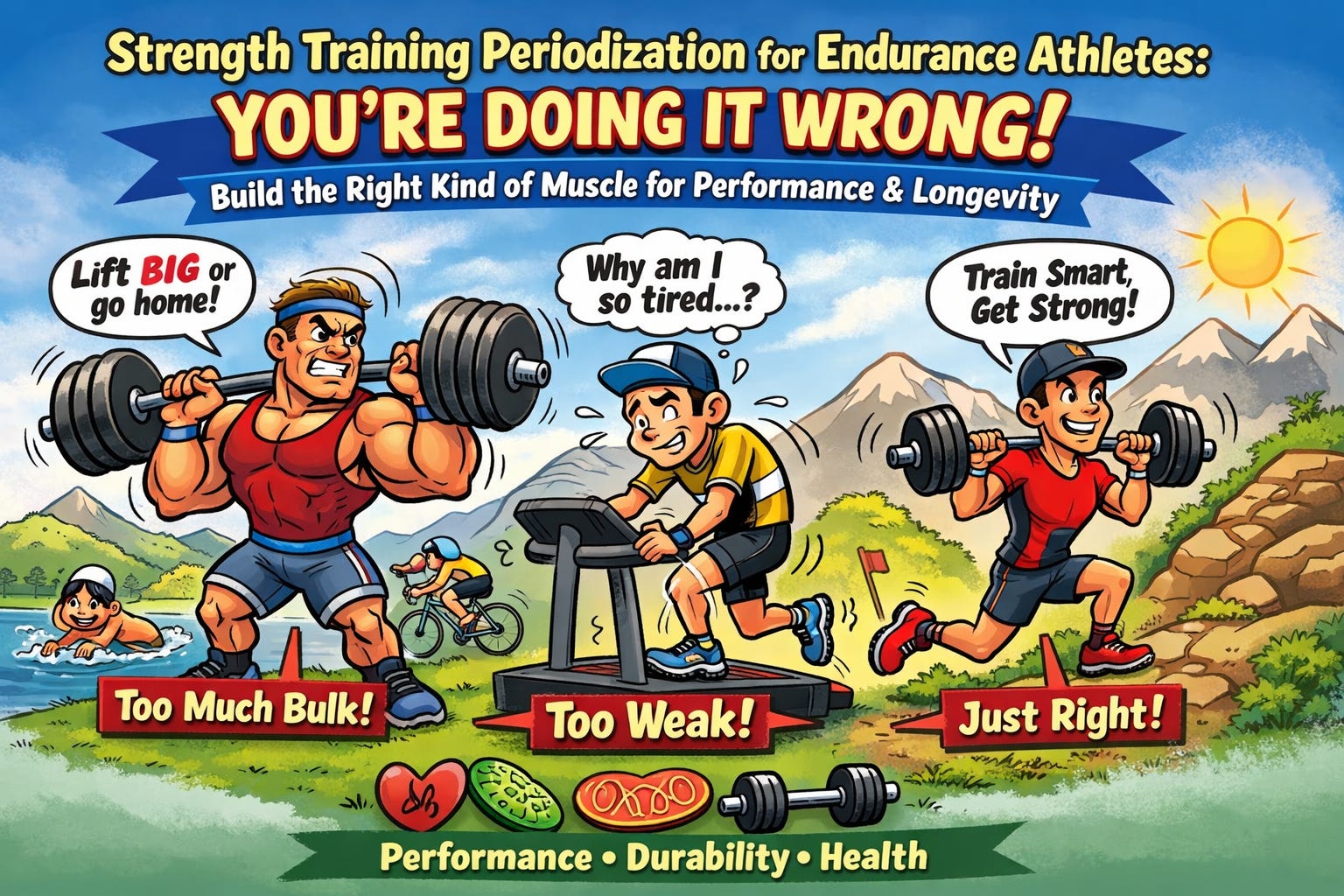
Endurance athletes often think of strength training as something optional - a supplement to the “real” work of swim, bike, and run. But, the physiological reality is the opposite: muscle moves things. Whether that “thing” is a barbell in the gym or your body over the course of an Ironman, it is the muscle that makes it happen.
For example, if you are a cyclist whose goal is to one day push a 53-12 gear at 90 rpm over a full 40k Time-Trial, the first and foremost requirement is that you have the strength to push a 53-12 gear - period! The next would be that you have the muscular endurance to push the 53-12 gear over 40km. Then the final stage would be that you have the aerobic fitness to push that gear at 90 rpm (without being limited by acidosis) over the course of the race. But it all starts with strength! If all you ever do in training is push a 39-15 (a much easier gear), you will simply never develop the muscle required to push the larger gear. In this sense, everything begins with strength.
In the words of physiologist Georg Neumann…
“For endurance sports, the development of aerobic strength-endurance is a performance reserve, for only this guarantees an increase in forward propulsion.”
That is, at a fundamental, mechanical level, it takes a certain amount of muscle to generate the force required to overcome a given resistance – whether pulling your body through the water, or generating the torque to push a given gear on the bike, or generating the required power to move your body mass x amount of meters per stride. Fundamentally…
“If you don’t have enough muscle to produce the power required to do what you want to do, you’re just not going to be able to do it.”
Of course, as endurance athletes, our real challenge becomes doing that thing repeatedly over very long durations, and for this, the quality of the muscle matters – the amount of mitochondria that we have per unit of muscle so that we can generate the energy aerobically, the ability of those mitochondria to make use of free fatty acids, so that we don’t prematurely deplete glycogen etc. – we’ll come to the importance of maintaining the aerobic quality of your muscle in a bit. But, at the root level, it all begins with having sufficiently large & strong muscle fibers that can overcome competitive levels of resistance.
What makes this fact especially important for endurance athletes, and something that really needs to be understood, is that our training tends to be chronically catabolic. High-volume aerobic work tears down tissues, consumes not just dietary energy but also structural components of the body, and, over the years, can gradually erode the very musculature needed to stay healthy and competitive! Plainly…
“Your typical serious endurance athlete spends a lot of the year in a catabolic state where the body is focused on using what it has to create energy. If this isn’t balanced out with regular time in an anabolic state, over time the athlete loses that muscle reserve needed to become better.”
This is why a well-timed anabolic phase - where we consciously focus on building the tissue back up - is such an important and all-too-often neglected part of every year.
Yet, many endurance athletes short-change this - year after year, making the mistake of coming out of the off-season believing it’s the perfect time to lose weight. They feel guilty after Christmas indulgences and resolve to do the standard New Years’ Resolution thing - cutting calories while increasing their gym intensity - a perfect recipe for blocking the very anabolic adaptations they assume they’re chasing. As my good buddy, Iñaki de la Parra puts it…
“If you’re still putting the work in the gym but not eating enough, there will not be any anabolism!”