

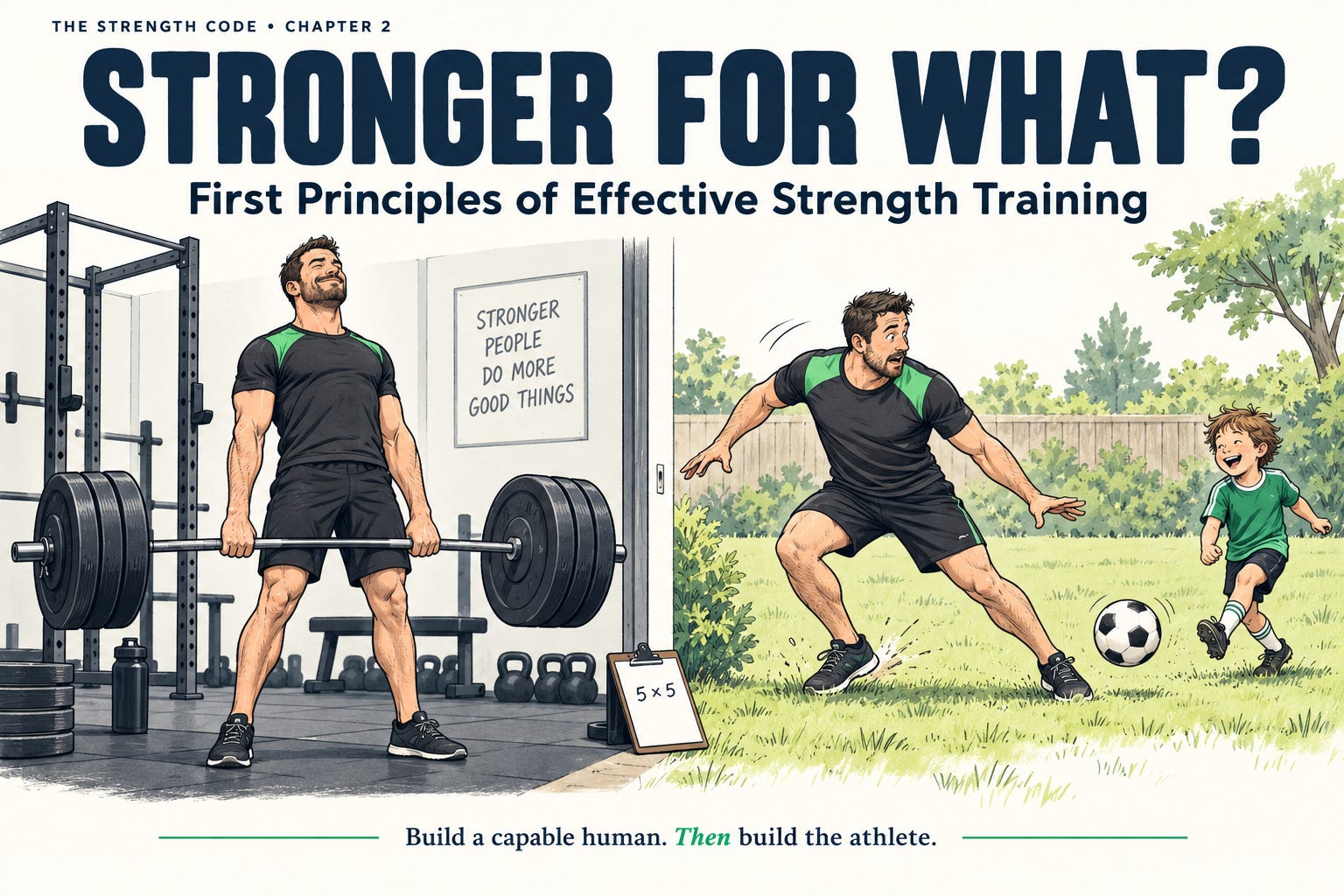
The Strength Code, Chapter 2. Build a capable human. Then build the athlete.
Imagine an athlete who can clean and jerk twice their bodyweight. They’re technically polished, brutally strong, and capable of moving a heavy bar from the floor to overhead in little more than a second. Then, on Sunday afternoon, they join a casual game of soccer with their kid, reach awkwardly for a pass, plant a foot and feel something go ping.
At first glance, this seems ridiculous. How can someone capable of handling twice their bodyweight be exposed by a movement that a ten-year-old performs without thinking? But this kind of scenario is all too familiar - for strength athletes, for power athletes, for endurance athletes, for any (over-) specialized athletes!
As we saw in Chapter 1, strength only has meaning in relation to a task. An athlete can develop exceptional strength in a handful of very specific tasks without being ready for moving laterally, decelerating or reacting outside that familiar groove. We can’t diagnose the cause of a hamstring going “ping” from a story, but we can immediately recognize the coaching problem: a very high peak doesn’t guarantee a broad base.
Like many aspects of modern life, strength training can become tribal - five sets of five, three sets of ten, Olympic lifting, powerlifting, bodybuilding, machines, free weights, slow lifting, fast lifting. Each camp has its favorite exercises and loading schemes, and each can produce impressive evidence that its approach works. But the question we keep missing is… works for whom, and toward what? When it comes down to it, our job as coaches is quite simple...
Identify what this athlete needs next and apply the safest, most efficient stimulus that develops it.
That’s the core training principle of both this book and The Endurance Code. However, implementing it in the real world is not as easy as downloading a twelve-week template. We need to begin with the person in front of us and change as the athlete changes.
Principles before prescriptions
In The Endurance Code, I began with principles rather than workouts because people can respond very differently to the same training. You’ll remember the Bouchard paper showing the spread in VO2max responses to a given program. Strength training is no different...
Ahtiainen and colleagues pooled data from 287 previously untrained men and women who completed twenty to twenty-four weeks of supervised resistance training twice per week.[1] On average, measured muscle size increased by 4.8% and leg-press strength by 21.1%. But those averages hid enormous differences: apparent changes ranged from -11% to +30% for muscle size and -8% to +60% for strength!
Some of that spread comes from measurement error, normal day-to-day changes and differences in the people and programs studied. While the data doesn’t prove that training caused muscle loss or that someone is a genetic “non-responder.” (using the control group to distinguish change from normal variation, the researchers classified 29% as low responders for muscle size and 7% for strength, but only 3% for both), it does clearly show that a single training program or method doesn’t change muscle size and strength to the same degree, or at the same rate, in every person.
Any single training method is useful for a given athlete, at a given time. Principles help us decide when that method fits and when it’s time to change. At the end of Chapter 1, we put those decisions into a developmental staircase:
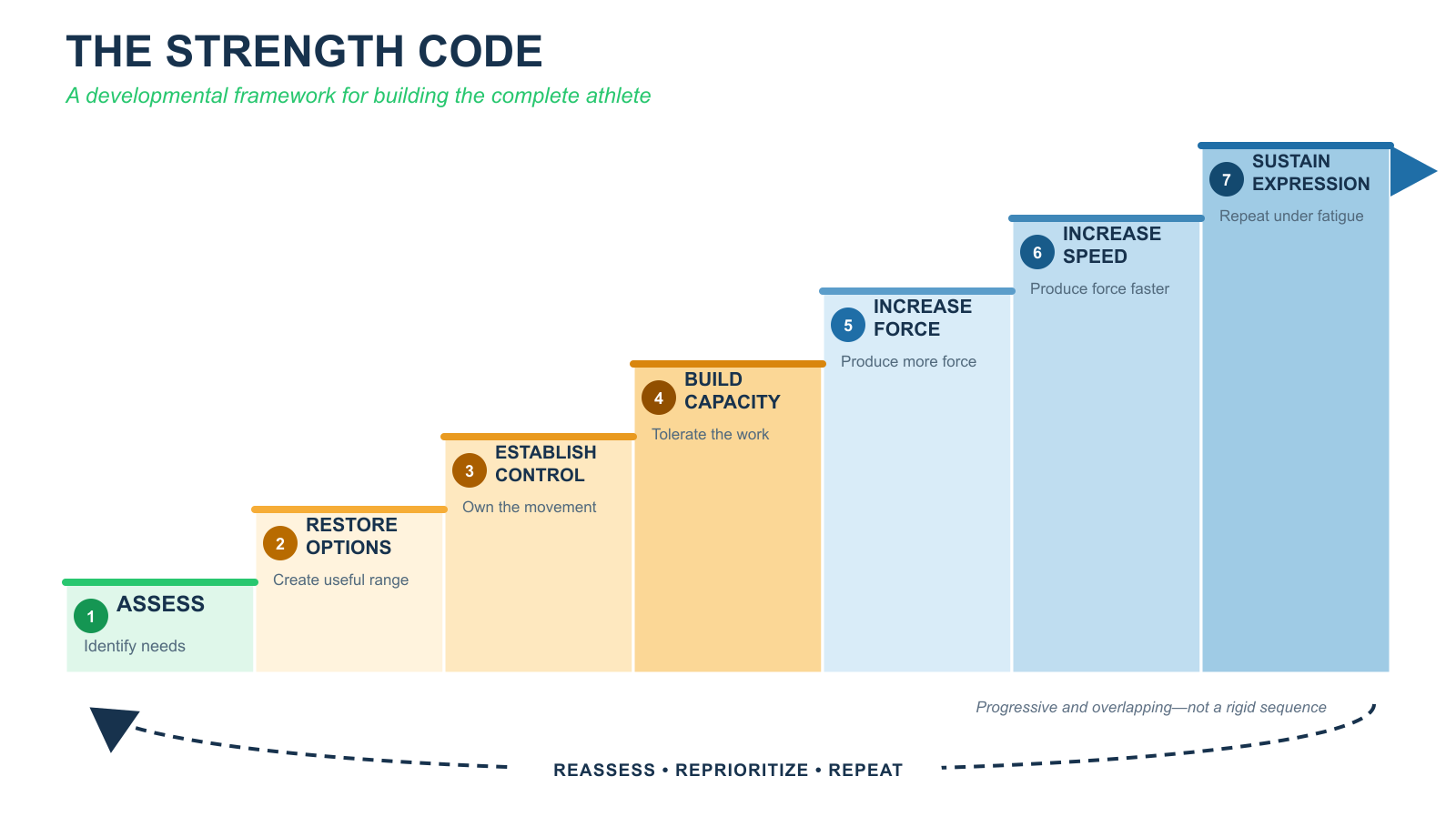
Figure 2.1: The Strength Code developmental framework. The staircase gives us a logical sequence, while the return arrow reminds us that development is an ongoing cycle of assessment, training and reassessment.
In plain language, the staircase gives us seven principles to work through:
Assess, don’t guess.
Restore a broad human movement repertoire.
Own the movement before loading the movement.
Build the work-capacity base.
Raise the force ceiling.
Make force available in time.
Keep force, speed and control when fatigue arrives.
And, we’ll climb that staircase step by step in this chapter.