

Before I finish my post on recovery rhythms, I thought a “HRV primer” might be in order. See, there is a lot of confusion around heart rate variability.
Much of this confusion comes from the fact that heart rate variability has become synonymous with one particular calculation – RMSSD, but there is a heck of a lot more to it than that!
To dig a little deeper into the nuances at play, let’s first go back to what HRV is physiologically linked to – the autonomic nervous system.
The autonomic nervous system is the non-conscious part of your nervous system that is always running in the background, regulating important processes like heart rate, breathing, blood pressure, and temperature.
The autonomic nervous system has two branches – sympathetic and parasympathetic.
Sympathetic Nervous System (SNS) — the “fight or flight” system.
Increases heart rate and blood pressure
Mobilizes energy (glucose, fats)
Prepares muscles and brain for action
Parasympathetic Nervous System (PNS) — the “rest and digest” system.
Slows heart rate
Promotes digestion, nutrient storage, repair, and immune function
Conserves energy
A healthy body shifts flexibly between these branches depending on the situation: sympathetic dominance during exercise or stress, parasympathetic dominance during recovery and sleep.
Since we have two distinct branches, we have four possible states at any one time…
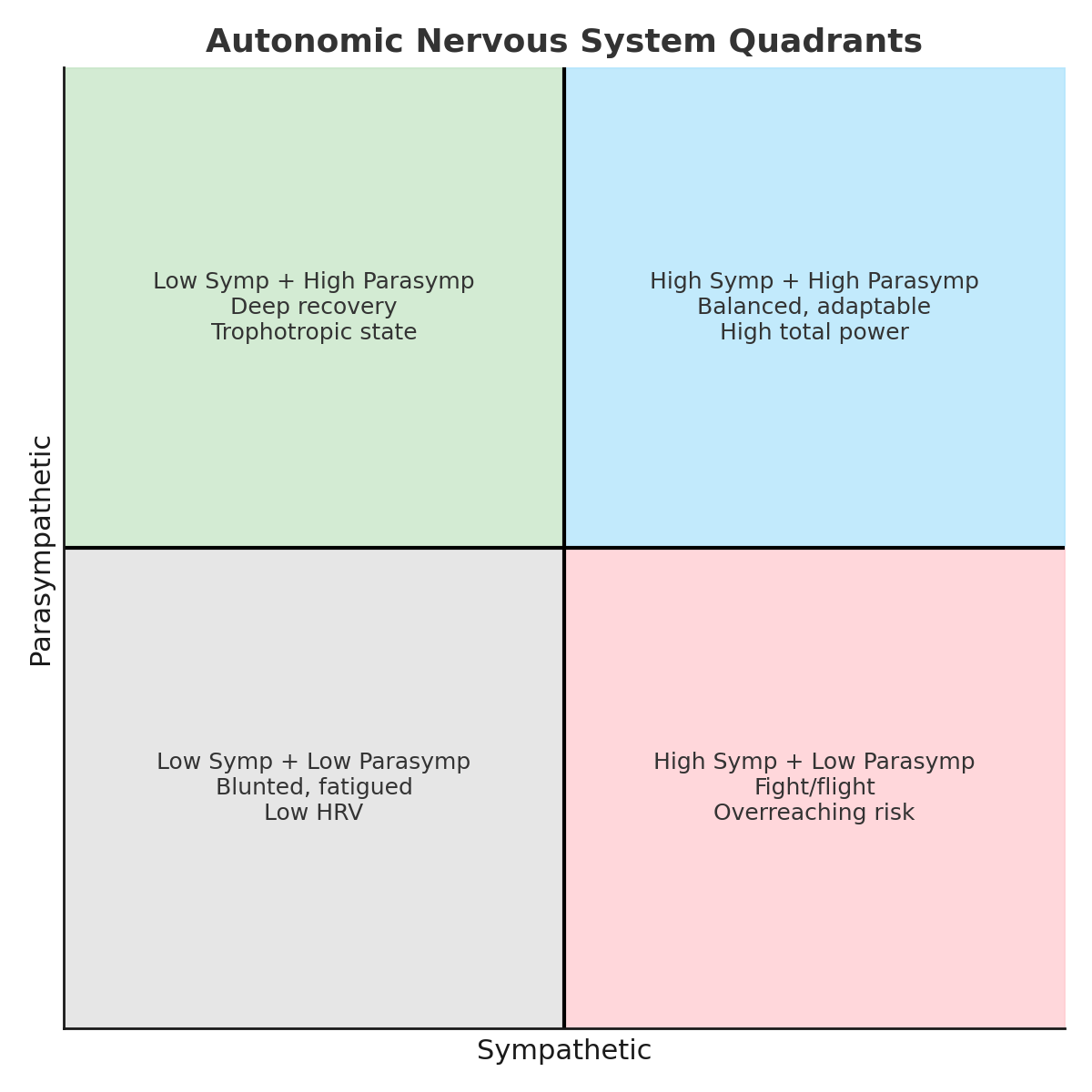
The athlete could have…
High Parasympathetic/Low Sympathetic – their recovery systems are strongly engaged, overwhelming their “fight or flight” system. They’re just plain tired – they want to sleep a lot, they might struggle to summon the energy to do work, they might struggle to elevate their heart rate. In short, they’re in a healthy trophotropic (deep recovery) vs ergotropic (deep work) state.
High Sympathetic/Low Parasympathetic – their “Do work” system is over-stimulated. They’re in sustained “fight or flight” mode, where generating energy to deal with a perceived stressor is more important than recovering from stress. This is fine in very small doses, but when it is sustained, when the athlete doesn’t take time to, or isn’t able to, “flip the switch” into recovery mode, the risk of serious overtraining is high.
Low Sympathetic/Low Parasympathetic – both readiness to do work and readiness to recover from work are low. If the athlete is in “fight or flight” mode (Q3) for too long, this is where they end up – without the resources to continue the work, or recover from the work.
High Sympathetic/High Parasympathetic – This is obviously the ideal state, where the athlete both has the power to do the work and to quickly “flip the switch” into recovery mode to recover from the work.
Sounds like knowing what state you’re in at any point in time could be useful in determining what you should be doing, right? So how do we go about figuring out what square we’re in right now? Enter HRV…