

Put a powerlifter, a gymnast, a sprinter, a rock climber, a rower and an Ironman athlete in the same room and ask a simple question...
Who is the strongest?
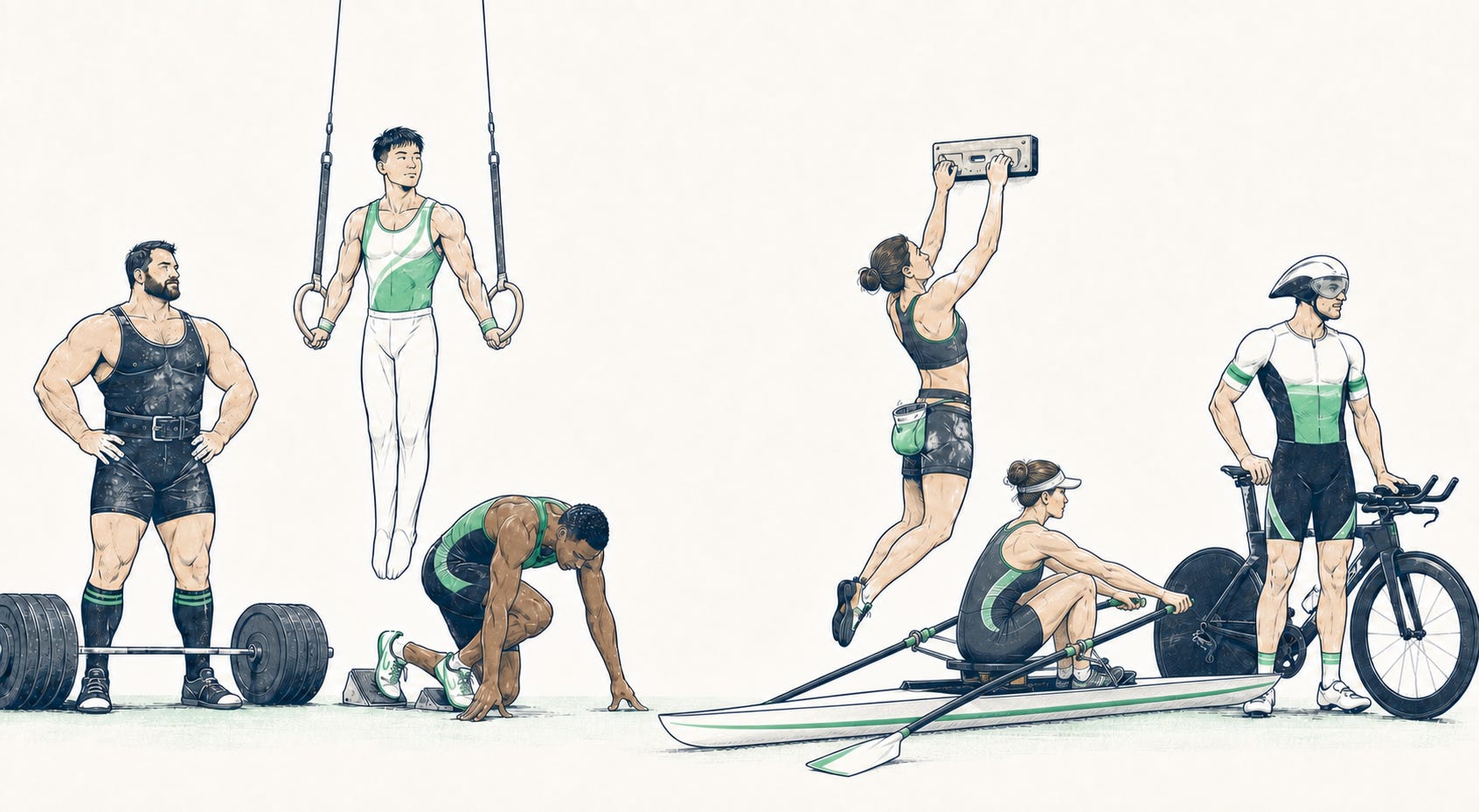
Who is the strongest? The answer depends on what we’re asking them to do.
The powerlifter will almost certainly lift the heaviest barbell. The gymnast may be able to hold their entire body horizontal to the floor, supported only by their hands. The sprinter can apply enormous force to the ground in a fraction of a second. The climber may hang their entire bodyweight from a hold barely wide enough to support the tips of their fingers. The rower can repeatedly apply high force to an oar for six or seven minutes, while the Ironman athlete can continue producing useful force, contraction after contraction, for eight, ten or fifteen hours.
In real-world sport, fatigue is another important variable to consider when asking that question - strong at what point in the game/event? Fresh and fully rested, the powerlifter would comfortably win any conventional lifting contest. But, ask the powerlifter and the Ironman athlete to complete ten hours of continuous work before repeating the test and the rankings might begin to change. At the very least, the Ironman athlete would retain a much greater percentage of their starting strength. The same would be true if we asked them to sprint, power their bike up a hill or repeatedly move a moderately heavy object. This gives us another important dimension to consider...
Strength isn’t only about how much force an athlete can produce. It’s also about how much of that force remains available when they’re tired.
...we might call this strength under fatigue, muscular endurance or fatigue resistance, depending on the task and how we’re measuring it. Whatever term we use, it matters enormously in sport (& life!). The strongest athlete at the beginning of a contest may not be the strongest athlete at the end. So, who’s the strongest?
Well... as you’re beginning to see, it depends. It depends on what we’re asking them to move. It depends on how quickly they must move it, how long they have to apply force, how many times they need to repeat the effort and whether they’re moving an external object or their own body. This might sound like a cop-out, but it gets us to the first key principle of the book:
Strength only has meaning in relation to a task.
In fact, all biomotor qualities only have meaning in relation to a task - endurance, speed, agility etc. And, furthermore, any task is a blending of these abilities. Even if we take it to the extreme...
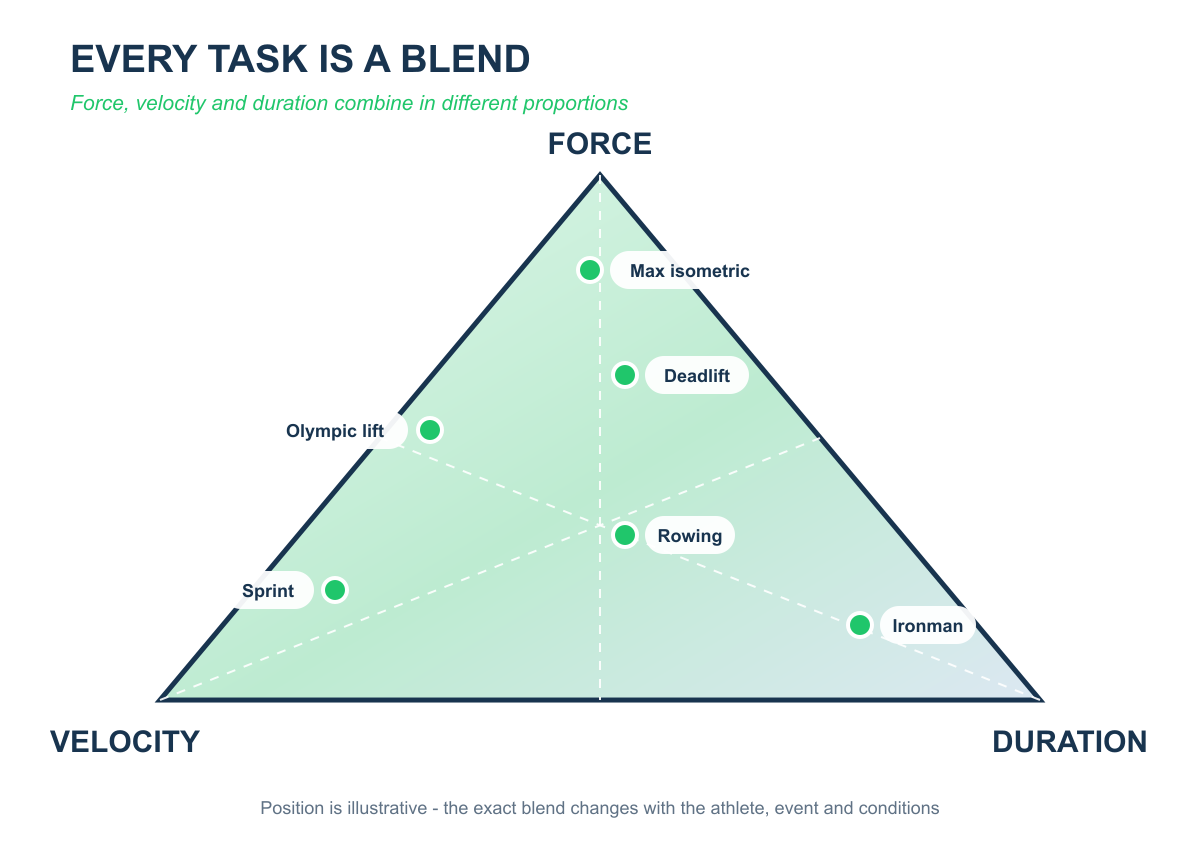
Figure 1.1: Every athletic task blends force, velocity and duration. The position of each event is illustrative - the exact blend changes with the athlete, event and conditions.
The triangle gives us a more useful way to think about athletic ability. A maximal isometric contraction - where the weight doesn’t move (zero velocity), and lasts only for a split second (minimal duration), sits very close to the force corner. A more realistic example - the Olympic lift moves toward velocity because the athlete has to accelerate a heavy load quickly - i.e. they need a combination of force and velocity - very high power. Sprinting moves even further down that line because it requires quite a high force, especially at the start, coupled with a very high velocity, but for only a short duration.
Rowing - a ~6 minute event of multiple moderate force contractions, moves further toward duration, while an Ironman - an 8-17 hour event sits close to that duration corner without ever completely escaping the need to produce force and movement speed. None of these tasks occupies a single point in the real world - when considering, individual differences and different priorities over an athlete’s development we could think of it more as a medium-sized range circle within the triangle - a range of potential FVD combinations that might “work” depending on the individual particulars of the athlete. But, the larger point being, this mental model makes the central idea clear - in the real-world...
Even the most apparently pure strength events contains some requirement for speed and endurance.
And, contrary-wise, even the events at the endurance extreme of the triangle carry some requirement for strength!
When most people hear the word strength, they picture a powerlifter deadlifting a heavy barbell. That’s understandable. A heavy lift is one of the cleanest and most visible demonstrations of force production. But, even in that case, there’s an element of endurance and speed at play...
A deadlift is a “grind” lift, meaning that it can take several seconds to get the weight to a point of lock-out. So, an essential part of being a good deadlifter is sustaining very high force output - not for the milliseconds that a sprinter or Olympic lifter might have to, but over the several seconds that it takes to complete the lift. Therefore, even the powerlifter has elements of speed and endurance at play. The closest thing to a true force event would be a very short isometric contraction - basically applying force quickly to a bar that doesn’t move. Not exactly a spectator sport :) As soon as you introduce movement or sustained contraction(s) over time, you get a blend of force, speed and endurance.
This is only one example. Each of the athletes we’re considering above - the rower, the lifter, the rock-climber, the triathlete - will have a different blend of force, speed and endurance - both absolute and relative to their body weight - that can leave them appearing either strong or weak depending on the task at hand...
The powerlifter might struggle to complete ten strict pull-ups, while the climber may not have an impressive squat. The Ironman athlete may have tremendous muscular endurance but very little force reserve, while the gymnast may control their own body beautifully but lack the absolute strength required to move a heavy opponent.
At modest levels, these qualities don’t necessarily compete. A relatively untrained athlete can improve their maximal strength, pull-up performance and fatigue resistance at the same time (and should!). But, as the athlete becomes more developed and we push one expression of strength toward its limit, the trade-offs become increasingly apparent. The muscle mass and bodyweight that help an athlete produce enormous absolute force must also be lifted during every pull-up and carried through every step of a long event. Likewise, training the fast-twitch fibers to produce a brief maximal effort isn’t the same as developing the metabolic and muscular characteristics required to repeat submaximal contractions for hours. Training time and adaptive resources are finite, so emphasizing one part of the strength profile inevitably leaves less room for another...
The closer we move toward the extremes, the more strength development becomes a series of trade-offs.
...the athlete with the highest deadlift probably won’t be the athlete who can complete the most pull-ups. Nor are they likely to retain the greatest percentage of their strength after several hours of continuous work. This isn’t a flaw in either athlete - it’s the nature of specialization...
It’s common for people to have an unrealistic view in their head of what their training is moving toward - a vision of themself as Superman/Superwoman - able to run a sub-two-hour marathon while nabbing a 1,000-pound deadlift on their way to the finish line...
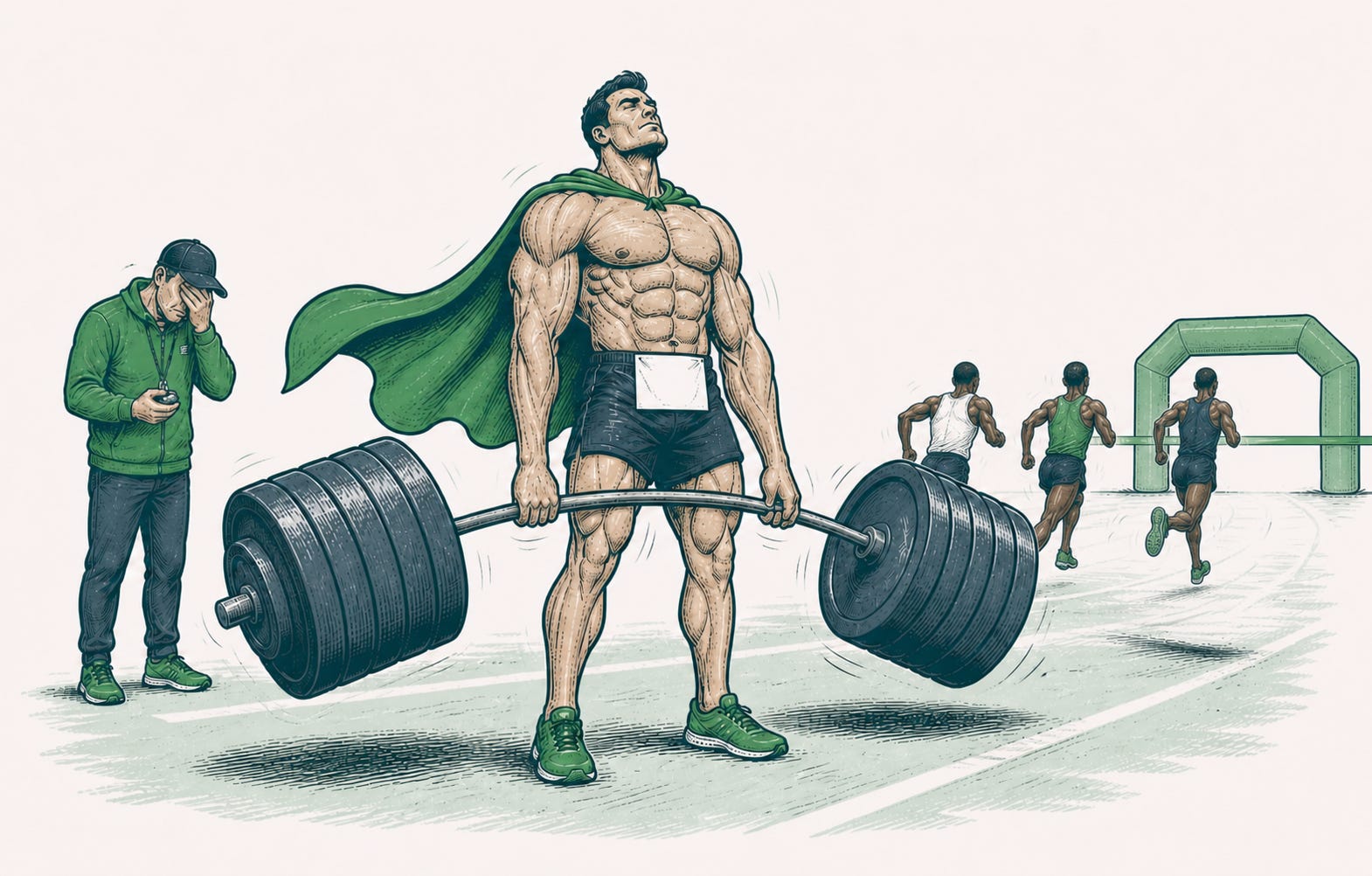
The mythical super-athlete: on their way to a sub-two-hour marathon, with a casual 1,000-pound deadlift along the way.
Much of a good coach’s job is to bring them back down to earth, to ask the important questions and focus in on the optimal combination that the athlete’s task demands require - the most useful compromise - i.e. where on the triangle do you wish to sit?
Range of motion adds another constraint. An athlete may be able to support an enormous load in a quarter squat but be unable to control a much lighter load through a full squat. The muscles are being asked to produce force at different lengths, the joints are moving through different positions and the leverage changes throughout the movement. We see this in the back-breakingly cringey posts on social media - “I did 5 (6 inch reps) today with 600 pounds 💪” Did you? Did you, really? These posts make it clear that strength isn’t only specific to the movement - it’s also specific to the range and joint positions through which it’s expressed. This is why a test result must always tell us how (and over what range) the movement was performed, not just how much weight was moved.
Stability places a similar constraint on strength expression. Most athletes can produce more force in a machine leg press, where the load and body are externally supported, than in a barbell squat. They’ll generally express less again in a split squat or lunge, where they have to control the pelvis, trunk and multiple joints over a smaller base of support. The sporting task is likely to be more demanding still - think of a footballer trying to accelerate while off balance, on turf, with an opponent closing in. The force-producing machinery might be there, but without sufficient control and an effective pathway for transmitting that force into the specific environment, much of its potential remains inaccessible. In my opinion, neither of these factors are considered enough when looking at, and testing, strength...
Range and stability aren’t separate qualities to strength. They are firm constraints on how much ‘pure strength’ the athlete can actually express in the real world!
...this is why restoring movement options and establishing control must come before the most aggressive loading in our developmental framework - because, as the old maxim goes - “You can’t shoot a cannon from a canoe!”
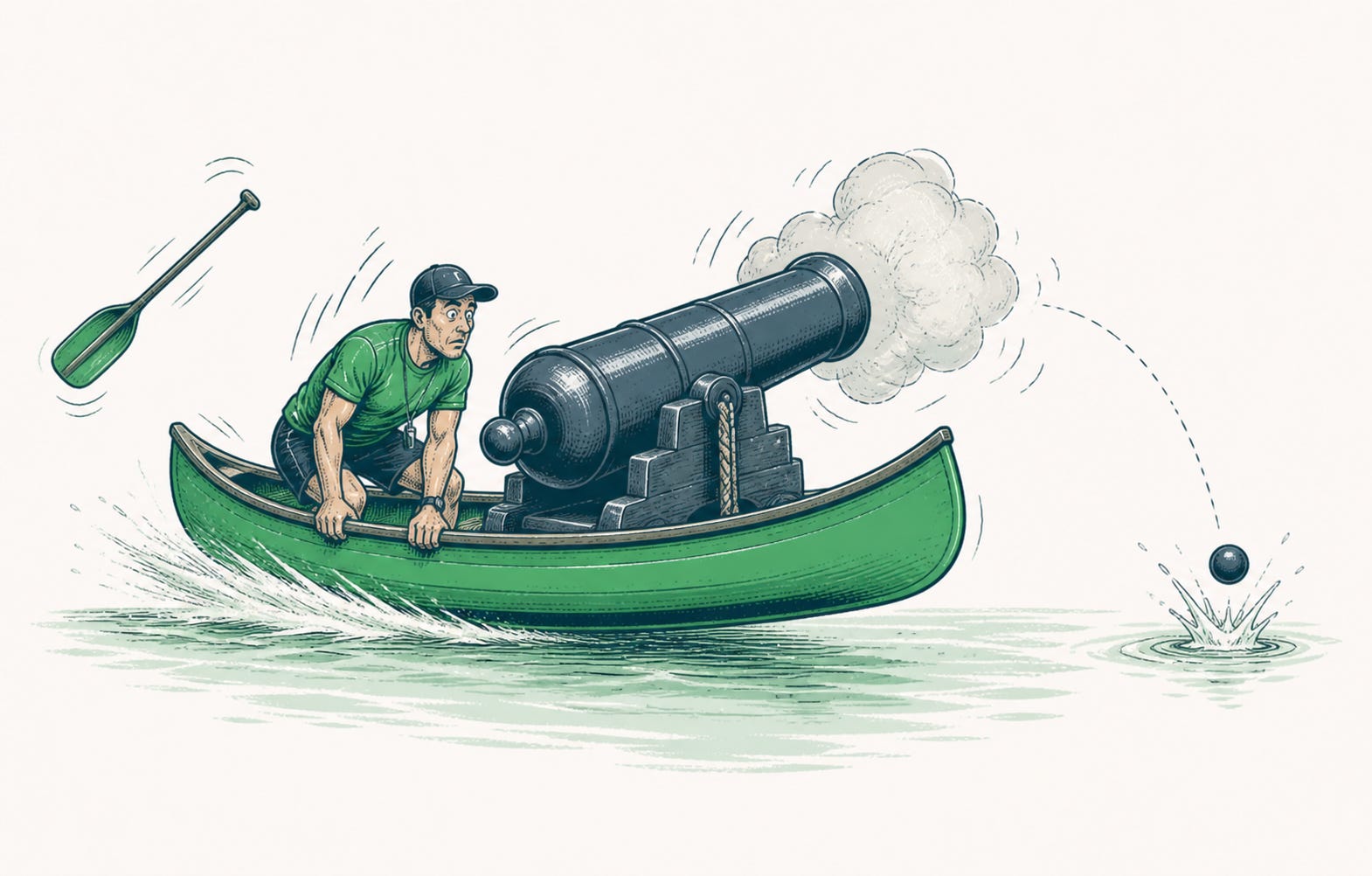
You can’t shoot a cannon from a canoe.
That is, in order to apply large levels of force, you need a stable (stability) base. These are key concepts that we will keep coming back to throughout the book. We’re not pursuing mobility or stability as cute additions to the “real” strength training or as isolated ends. We’re giving the athlete access to the positions required by the task and the ability to produce, accept and redirect force within them in the real world
For all of the reasons above - the range that we are expressing strength over, the movement and surrounding environment in which we’re trying to express the strength, how quickly we need to express the strength, whether our bodyweight is a significant part of the load we’re trying to overcome, there is no universally strongest athlete...
There is only the athlete who is (or isn’t) sufficiently strong for the task at hand.