In the last piece, we built a season the way a rocket scientist would.
We started with a simple model - Mr. Middleman - and walked through how a well-sequenced year stacks adaptations: base as the main engine, intensity layered as staged boosters, fatigue carefully managed across the build, and fitness peaking exactly when it matters. Get the sequence right, and you arrive at the start line with lift-off. Get it wrong, and you end up with a series of misfires - good work, poorly timed.
But there was an important caveat at the end of that piece.
The blueprint works… for Mr. Middleman.
And most athletes aren’t Mr. Middleman.
While the general sequence we outlined—Base → Tempo → Threshold → Sharpening -is physiologically dictated by the time course of adaptation, the time spent in each phase and the benefit derived from each can vary dramatically between athletes.
This is especially the case for the latter phases. In this piece we’ll focus on the last half of the season - the Specific Prep period where we start to tailor the training to the specifics of the athlete. For the General Prep phase, the base phase, that we discussed as the early season emphasis in the last post, developing a solid work capacity is a general attribute, that all athletes will benefit from to a large degree, irrespective of the specifics of their physiology and event.
However, when we get to the latter half of the season, you’ll find that athletes respond differently to the various options - large volumes of tempo work, focused threshold training, or more intensive interval work. For this reason, identifying some of these differences between athletes can make a significant difference in how much performance improvement occurs for that athlete in the latter half of the build.
From the General Blueprint to Individual Adjustment
When I began looking at some of these differences in athlete response through a mixed-effects model, that point became even clearer…
At its core, a mixed-effects model separates what tends to work across the group from how each individual deviates from that pattern. In coaching terms, it’s the difference between the default sequence and the way a specific athlete bends that sequence.
What emerges from that isn’t a completely different plan for every athlete. It’s something much more practical…
The structure stays the same. The sequence is still there. But the weighting of that sequence - the relative importance of each phase, and the timing with which those phases arrive - shifts depending on the athlete.
So the coaching task becomes one of interpretation rather than invention. We are no longer asking, “What plan should this athlete follow?” but rather, “Where does this athlete sit relative to the model, and how should the ‘prototype season’ be adjusted accordingly?”
A Very Brief Geeky Interlude… 🤓
For those curious what sits underneath this, the following analysis comes from a mixed-effects model - a statistical approach that looks at two things at once. It captures the average response across a group of athletes (what tends to work in general), while also estimating how each individual athlete deviates from that average. In practical terms, it allows you to separate the “default plan” from the way a specific athlete bends that plan - toward more base, more intensity, or different timing of both.
But, something very important that I want to emphasize:
You don’t need a mathematical model to see this.
A trained coach’s eye, given enough exposure to athletes over time, will start to recognize these patterns intuitively. You’ll notice the athlete who doesn’t come alive until the final weeks. The one who just keeps improving the longer the build goes. The one who only seems to move when tempo is introduced.
The model doesn’t create these patterns. These are (likely genetic) archetypes that have existed long before computers started to mathematically describe them! The model just makes some of these patterns easier to see…
Making the Invisible Visible
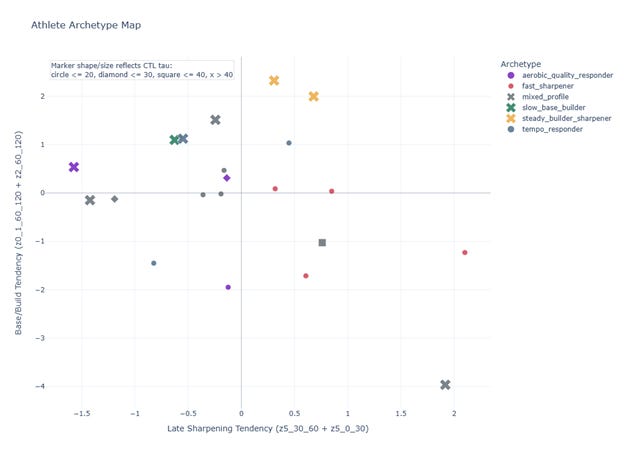
One of the challenges with the idea of different athlete ‘types’ is that, without some way of visualizing it, it can feel abstract. Since we’re looking at response to multiple training zones over multiple time lags, e.g.
How much does zone 5 work impact the athlete’s fitness 30 days out from the race?
How about 120 days out?
Which is a better emphasis 60 days out - zone 5 sharpening or zone 3/4 tempo work?
In other words, there are a lot of variables in play at any one point in time. We can talk about athletes responding “more” or “less” to certain types of work at certain points within the training build, but that’s difficult to hold in your head in any structured way.
That’s where mapping and clustering some of these differences into different athlete “archetypes” comes in very handy…