

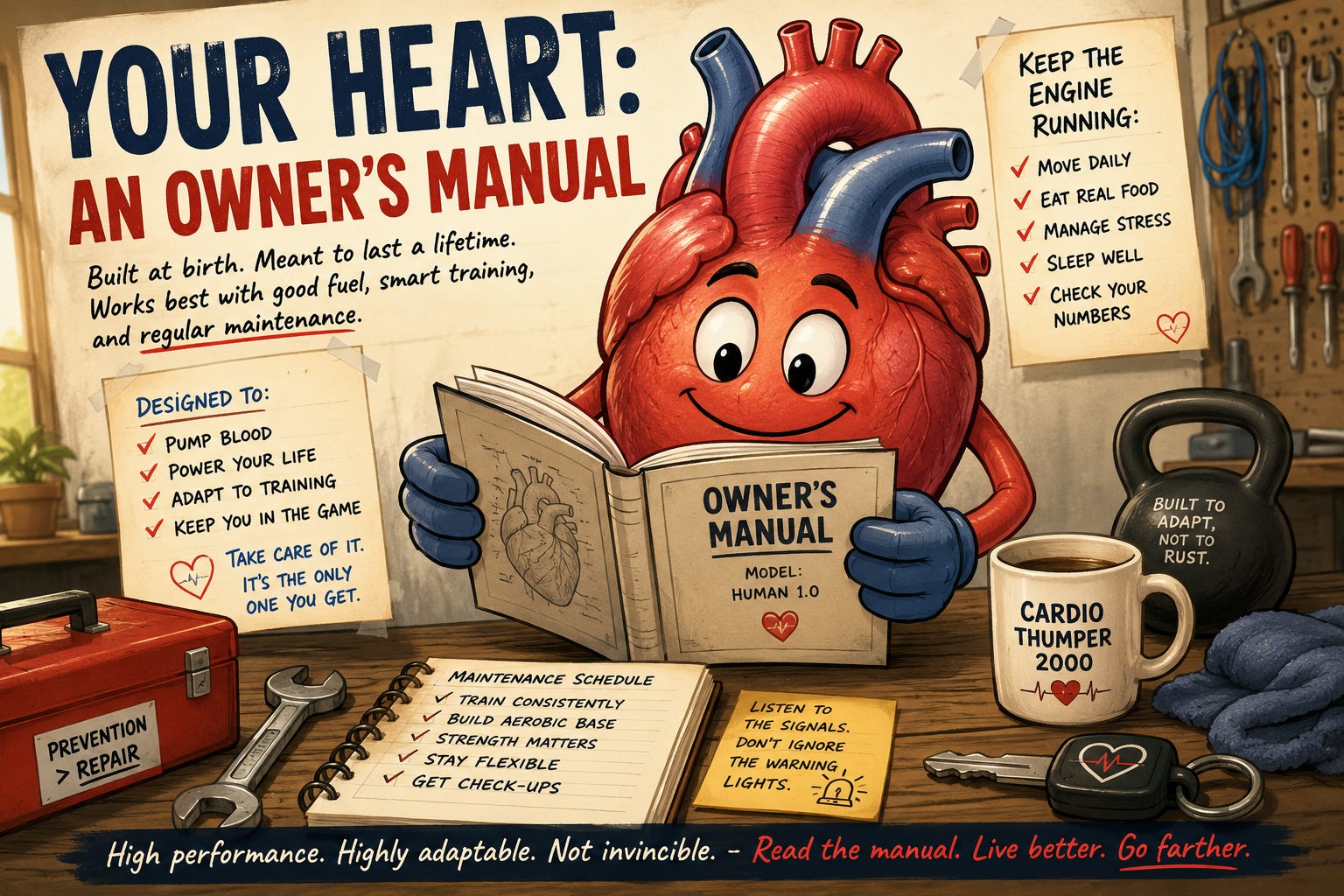
Most complex machines come with an owner’s manual.
Your car comes with one. Your washing machine comes with one. Even the weird little Bluetooth meat thermometer that you bought during your “I’m going to reverse sear everything now” phase comes with one.
Your heart, on the other hand, does not.
Which seems like a fairly major oversight, given that it’s the one piece of equipment that you truly *depend on*. Forget to put oil in your car and blow the engine? Bad day. Blow up the engine in your chest? Considerably worse day.
Furthermore, it is the one machine that is expected to operate continuously, under wildly varying conditions, for somewhere in the neighborhood of 3 billion beats(!) over 80 to 100 years - often while caffeinated, sleep deprived, emotionally unstable, metabolically challenged, and occasionally sprinting uphill because… Strava.
And, not to be a downer, but, even for active people, for about a third of us, failure of this all important engine will ultimately be the thing that takes us out – as I explained here
So, consider this a small attempt to correct this glaring omission from your yellowing pile of owner’s manuals.
This isn’t a cardiology textbook. Nor is it a replacement for seeing an actual cardiologist if your dashboard lights start flashing. Instead, it’s a practical owner’s manual for the endurance athlete, aging athlete, or generally health-conscious human who would like to understand what this organ is, what can go wrong with it, and how training can be both one of the best things you can do for it and, in a few specific contexts, something that needs to be handled with a little respect.
Because, as André La Gerche and Guido Claessen emphasized in our recent Mad Science Meets Real Life podcast conversation , the heart is not just a passive lump of meat that reluctantly supports your training habit. It is a highly adaptable, highly trainable organ. It remembers what you have done. It changes dramatically in response to load. And, like any high-performance engine, it can become beautifully upgraded through sensible use - or occasionally develop some annoying “quirks” if you insist on redlining it every time you leave the driveway. So, without further ado, let’s get to know yours!
Part 1: Meet your machine
Congratulations on your ownership of the cardio-thumper 2000!
With a little knowledge and a little TLC, your cardio-thumper will serve you faithfully for decades to come.
Let’s begin by looking at the operation of your cardio-thumper 2000 in a little more depth and exploring some of its features…