
Physiological Periodization:
Respecting the natural recovery rhythms of *your* body

“When hungry, eat your rice; when tired, close your eyes. Fools may laugh at me, but wise men will understand” – Linji Yixuan
Assuming you are human, every one of your days on this earth is broken into two distinct periods – awake/working and sleeping/recovering. This basic rhythm is absolutely integral to health. When this rhythm is disrupted, even partially, even briefly, the consequences for health and recovery are significant.
While this is the most obvious and familiar work-recovery rhythm, it’s not the only one…
Our brains and bodies have a number of these rhythms operating at different scales throughout our lives. And, while less obvious than the daylight-nighttime cycle that we are familiar with, failure to adhere to them can be just as damaging.
In my last post, I talked about the “next dimension” of HRV monitoring, i.e. looking at both our “readiness to recover” AND our “readiness to work”. With the former represented by the strength of the High Frequency component of our Heart Rate Variability and the latter represented by the strength of the Low Frequency component. In that post we looked at some of the influences of both life and training that can push us in one direction or another. For example, excessive caffeine use can drown out the HF ‘rest and repair’ signal so effectively that, over time, the parasympathetic system struggles to engage at all, and we find ourselves “tired but wired” with poor sleep and poor overall recovery.
However, while very important, the day sleep-wake cycle isn’t the only cycle that we should be mindful of when it comes to recovery. No, just as HRV oscillates on different time scales, so too does your body. Over periods of a few hours, a day, a week, a month, a year, your body goes through natural work-recovery cycles. Where the readiness for work (LF) rises for the first half and then readiness for rest and recovery (HF) peaks in the second. Each of these work-recovery rhythms is essentially a zoomed-out version of that same wake-sleep LF/HF dance.
And, failure to pay attention to these cycles, or an attempt to continually ignore or override them results in that same elevator trip that I spoke about in the last post, i.e. your ability to “flip the switch” into parasympathetic mode gradually declines and you get stuck in that poor recovery, pro-inflammatory, perpetual “fight or flight”. For these reasons, it is absolutely crucial for both your recovery as an athlete and your health as a human that you get to know your own body’s natural, physiological, work-recovery cycles.
Let’s begin that process by taking a look at how different types of recovery progress over different time spans before taking a look at some of these specific cycles and their impact on your athletic recovery and overall health.
Recovery Timescales
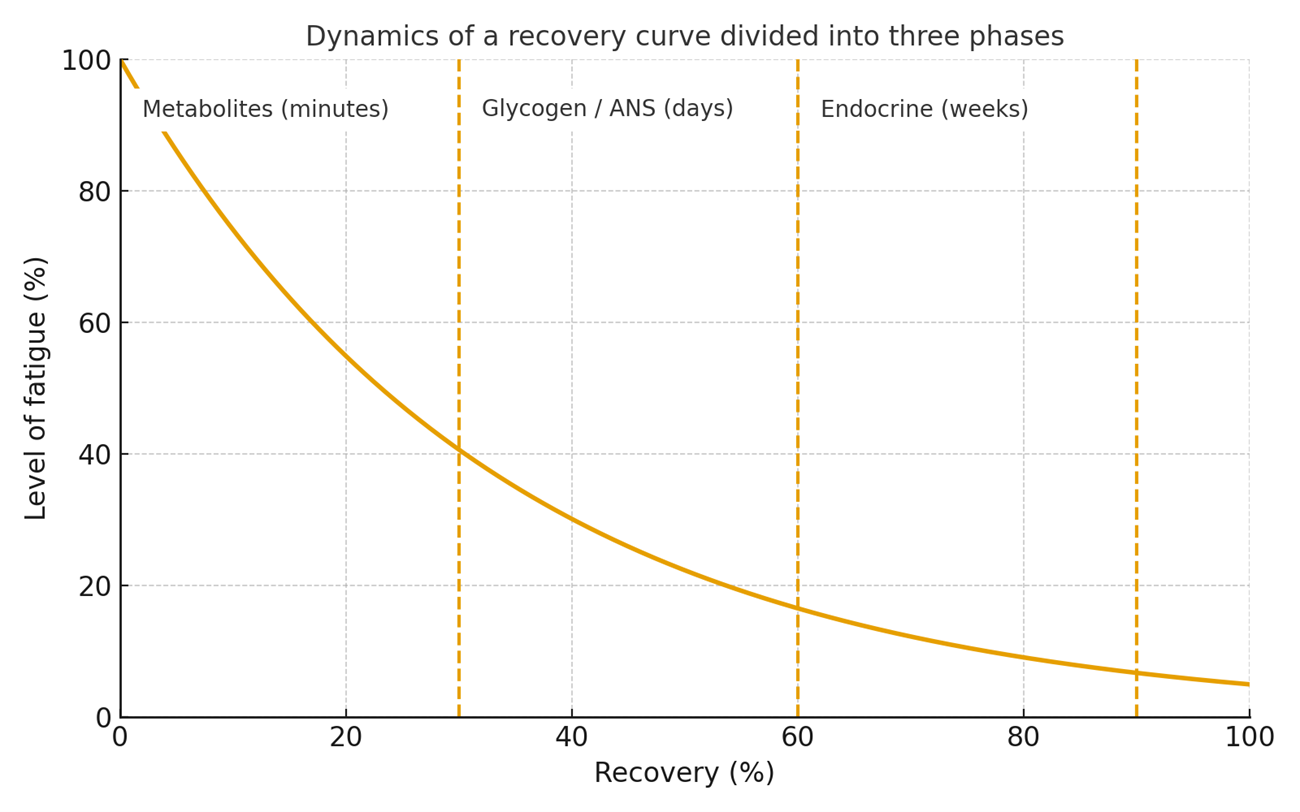
As shown in the figure above recovery doesn’t happen all at once. It unfolds in distinct phases, each governed by different physiological systems and timescales. The first 70% of recovery happens fast — minutes to hours — as metabolites are cleared and ionic balance in the nervous system is restored. The next ~20% takes days, driven by glycogen replenishment and the rebalancing of the autonomic nervous system. The final 10% is the slowest of all, stretching over weeks, as endocrine and connective tissue systems catch up. In practical terms, this means that while you may feel recovered enough to train again after the quick phase, deeper systems are still restoring beneath the surface.
Respecting each layer of this curve — from metabolites to hormones — is essential if you want to not only bounce back, but adapt and grow stronger over time.
Keep reading with a 7-day free trial
Subscribe to The Science of Maximal Athletic Development to keep reading this post and get 7 days of free access to the full post archives.